
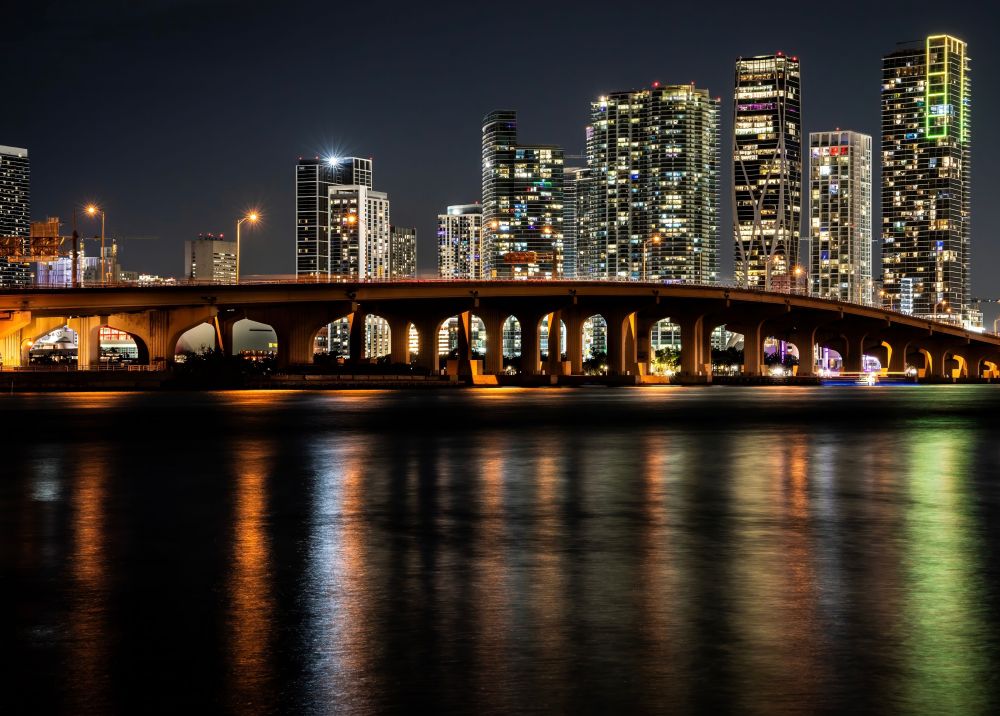
The Miami Beach Bridge dispute has escalated into a federal lawsuit involving luxury condo developer Crescent Heights, Terra and the city of Miami Beach. Hedge fund executive Jay Newman and the association representing the 48-story Five Park condominium tower allege fraud and violations of federal land sales law over a pedestrian bridge that remains unbuilt. The lawsuit seeks damages tied to the delayed project, according to Bloomberg.
Newman, known for his role in Elliott Investment Management’s $4.7 billion settlement with Argentina, purchased a penthouse at Five Park for $17.3 million in 2024. His purchase came about a month after the 227-unit condominium building at 500 Alton Road was completed.
The planned pedestrian crossing was an important part of the development agreement behind Five Park. However, the project has stalled after developers said underground electrical infrastructure makes the bridge unsafe to build according to its original design. The dispute now raises questions about developer commitments, public access and the responsibilities of local officials.
Miami Beach Bridge Lawsuit Targets Developers
Newman and the Five Park condominium association filed their lawsuit in federal court on October 13. The complaint names the joint venture of Crescent Heights and Terra, along with the city of Miami Beach. It alleges fraud and violations of federal land sales law in connection with the missing pedestrian bridge.
The legal action follows years of planning for a crossing intended to improve pedestrian access around the development. Newman paid $17.3 million for his penthouse, placing him among the high-profile property owners with a direct interest in the project’s promised amenities and surrounding infrastructure.
The lawsuit puts the developers’ commitments under scrutiny. It also raises questions about the role of the city, which participated in the arrangements surrounding the planned public improvements.
However, the allegations remain disputed. The developers’ attorney, Michael Thomas, said the joint venture disagrees with the claims and believes the lawsuit presents a one-sided account of the project’s circumstances.
The dispute is particularly notable because Five Park is a prominent luxury condominium development in Miami Beach. The stalled bridge has become a source of frustration for residents and a challenge for the developers and city officials seeking a workable solution.
How the Miami Beach Bridge Agreement Began
The proposed crossing originated in a 2019 agreement involving Terra, led by David Martin, and Crescent Heights, associated with Russell Galbut. Under the arrangement, the developers planned to create a public park in exchange for approvals connected to the project that became Five Park.
The 48-story tower has become one of Miami Beach’s tallest residential buildings. The planned public improvements were intended to support the surrounding community as the development added new homes to the area.
French conceptual artist Daniel Buren designed the proposed pedestrian walkway. The bridge was expected to offer people a way to cross the busy area without having to navigate the roadway directly.
Funding was divided between the city and the developers. Miami Beach set aside approximately $10 million for the bridge, while the developers were expected to cover the remaining cost.
The agreement linked private development with a public benefit. The park and pedestrian crossing were intended to improve the area beyond the condominium property itself. As a result, the bridge’s continued absence has become a wider public issue rather than simply a disagreement over a private building amenity.
The delay also highlights the challenges that can arise when major developments depend on infrastructure projects involving several public agencies, private companies and utility providers. Even when an agreement sets out the original plan, unexpected engineering and access issues can complicate construction.
Underground Power Lines Block Miami Beach Bridge Plans
The main obstacle involves Florida Power & Light transmission lines buried approximately 50 feet underground. In August, the developers said the pedestrian bridge could not safely be built according to its existing design because of the underground electrical infrastructure.
The location of these lines creates a difficult engineering problem. Bridge foundations must be designed with adequate separation from underground utilities, while construction work must protect both workers and the surrounding infrastructure.
City officials have also pointed to uncertainty over the legal requirements governing the project. According to officials, state law does not clearly establish the vertical clearance required between bridge foundations and utility lines in this situation.
Furthermore, FPL is not obligated to assist with relocating the transmission lines. Moving the infrastructure could cost tens of millions of dollars, according to Miami Beach City Manager Eric Carpenter, who discussed the issue during a commission meeting.
Those potential expenses could substantially increase the overall cost of the project. They also raise questions about who would be expected to pay for relocation and whether the original funding arrangement could accommodate such a large additional expense.
The developers have said that engineers evaluated the proposed bridge and concluded that proceeding with the existing design would pose too great a risk. Their concerns include public safety, construction workers and the city’s power grid.
These findings have left the project at an impasse. The city wants to preserve the planned pedestrian connection, but the original design may require changes before construction can proceed safely.
Miami Beach Orders an Independent Engineering Review
In September, Miami Beach commissioners ordered an independent engineering review of the proposed bridge. The review is intended to assess the developers’ conclusion that the structure cannot be built safely as designed.
An independent assessment could help officials determine whether the existing plan can be modified or whether a different solution is necessary. It may also provide a clearer technical basis for deciding how to proceed with the project.
The review is important because the city has not abandoned its preference for a bridge. Officials are still seeking a way to allow pedestrians to cross the area without walking through traffic, while also accounting for the underground utilities and other constraints.
However, the city does not control the right of way needed for the project. That area is controlled by the Florida Department of Transportation, and multiple utilities run through the location.
Consequently, resolving the issue may require coordination between the city, developers, state transportation officials and utility providers. Any revised design would need to account for the technical limits of the site and the relevant approval requirements.
The review could therefore influence more than the bridge’s immediate construction schedule. Its findings may help determine whether the existing agreement remains practical or whether the parties need to consider another approach.
Alternative Crossing Could Replace the Miami Beach Bridge
Miami Beach Mayor Steve Meiner has suggested that, if the original bridge proves unfeasible, the developers could be required to redirect money earmarked for it toward another pedestrian solution.
The goal would remain the same: allow people to cross Fifth Street and the MacArthur Causeway without having to traverse the roadway. A different arrangement might avoid some of the engineering obstacles associated with the proposed bridge, although any alternative would still need to meet safety and access requirements.
For now, the bridge remains the city’s preferred option. However, officials must balance that preference against the constraints presented by underground utilities, the location’s ownership and the costs associated with modifying the infrastructure.
An alternative would also raise questions about the original development agreement. The parties would need to determine how the funds should be used, what type of crossing would meet the public objective and whether further approvals would be necessary.
Redirecting the money could provide a path forward if engineers conclude that the original structure cannot be built safely. Nevertheless, the final decision will depend on the technical review and discussions among the parties involved.
Developers Dispute Claims as Frustration Grows
The parties have expressed different views about the stalled project. Crescent Heights was not immediately available for comment, while the city of Miami Beach declined to comment on the lawsuit.
Terra’s David Martin told The Real Deal that the developers share the community’s disappointment. He said engineers had evaluated the project but could not identify a safe alternative for building the bridge according to its original design.
Martin also emphasized the risks that construction could pose to the public, workers and the city’s power grid. The developers’ position is that proceeding without resolving those concerns would be unsafe.
Their attorney, Michael Thomas, said the joint venture disagrees with the allegations in the federal complaint. He also argued that the lawsuit provides a one-sided account of the project’s circumstances.
The disagreement now involves both technical questions and legal claims. Engineers must assess whether the proposed structure can be built safely, while the court case will address the allegations raised by Newman and the condominium association.
The outcome could affect how the parties approach the bridge commitment and any potential financial responsibility. Until the technical and legal questions are resolved, the project’s future remains uncertain.
A Second Lawsuit Adds Pressure on Five Park Developers
The bridge dispute is not the first legal challenge involving the Five Park development. Newman filed a separate lawsuit in Miami-Dade Circuit Court last year against Crescent Heights and Terra.
That complaint alleged that the developers failed to make short-term guest suites available for condominium owners’ invitees, despite allegedly promising those suites as part of the project’s marketing. The case remains ongoing.
In their response to that complaint, the developers’ joint venture denied wrongdoing. It said the short-term guest suites were not yet available but would be made available for use by any unit owner.
The two lawsuits concern different issues, but both involve expectations surrounding the development and the commitments made to buyers. The guest-suite case focuses on an alleged promise involving shared accommodation, while the federal case concerns the delayed public pedestrian bridge.
Together, the disputes place additional attention on the developers’ obligations and the delivery of promised features. They also highlight the importance of clear agreements and timely communication when buyers make high-value property purchases.
However, the allegations in either case should not be treated as proven findings. The bridge lawsuit and the guest-suite dispute remain subject to their respective legal processes.
What the Miami Beach Bridge Dispute Means
The stalled crossing illustrates the difficulties that can emerge when private real estate development is tied to public infrastructure. The original plan involved a public park, a pedestrian bridge, shared funding and approvals for a major condominium project. Underground utilities and uncertainty over construction requirements have since complicated delivery.
For residents, the main concern is whether a safe pedestrian connection will eventually be provided. For developers, the dispute involves engineering risks, potential legal exposure and the cost of fulfilling the original commitment. City officials must also weigh public access against the limits of the site and the authority of other agencies.
The independent engineering review may be a crucial next step. If it identifies a safe way to modify the bridge design, the parties could have a route toward construction. If not, officials may need to pursue a different crossing and decide how the allocated funds should be used.
Meanwhile, the federal lawsuit will continue to test the allegations made by Newman and the Five Park condominium association. The developers have rejected those claims, leaving the dispute unresolved.
The future of the Miami Beach Bridge will depend on the engineering findings, the negotiations among the parties and the legal process. Until those questions are settled, the promised crossing remains a source of uncertainty for Five Park residents and the surrounding community.

